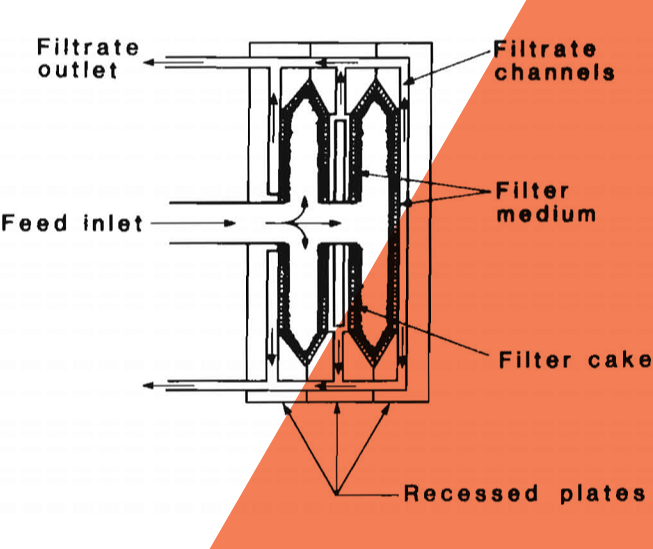
An Interconnected Dewatering Circuit
In mineral processing, the filter press is often used like a standalone unit. It sits at the end of the line and takes the blame when things go wrong. When throughput drops, production targets are missed, concentrate ships don’t get loaded, and hardware wears out ahead of schedule, the instinct is to blame the press.
In many cases, that is the wrong place to look. The filter press is the canary in the coal mine, identifying what the thickener has been doing wrong. The press’s efficiency is capped by the quality of the feed coming in. The press can only work with what the thickener gives it. Most of what looks like a press problem traces back to erratic underflow density and uncontrolled settling.
Underflow Density as the Primary Driver of Filtration Efficiency
The percent solids in the thickener underflow is the single most important variable in how quickly a filter cake forms . A press running 45-minute cycles instead of 30-minute cycles is not a press problem. It is a feed problem. That 15 minutes compounds across every cycle, every shift, every day. It is the difference between hitting your tonnage target and explaining to management why the ship didn’t load.
Low underflow density means the press has to process more liquid to recover the same amount of solids. That extends fill times and wastes energy. The initial cake layer that builds on the filter cloth quickly becomes the primary filtration barrier. If the feed is dilute, that layer forms poorly and unevenly. From there, cake resistance climbs as the cycle runs
Further, low underflow density feed is prone to carrying a higher proportion of unsettled fines. Those fines pack tightly and create a nearly impermeable cake base layer that stops filtering and starts plugging. At that point, adding pressure does not help. Poor flocculant control makes this worse: the thickener sends slugs of unsettled fines directly into the press. Clay-type fines are highly water-retaining and will blind filter cloths quickly, often irreversibly within a single bad cycle.
How Erratic Thickener Performance Destroys Hardware
Press damage. Stable underflow density produces consistent cake formation. Consistent cake formation means every chamber fills to roughly the same thickness every cycle, and the plates seat on a predictable load. When underflow density swings, cake thickness swings with it. Misaligned or damaged filter plates lead to slurry leakage during the filtration cycle and can cause beam bending which over time compounds the problem. The misalignment is a mechanical symptom. Thickener underflow density is the cause.
Pump, pipe and valve wear. Feed pumps for filter presses are sized for a target flow rate and solids loading. When underflow is dilute, operators must push more volume through the system to recover the same tonnage of solids. Flow velocity has a dominant effect on wear rate. Every percent drop in underflow solids that gets compensated by increased pump speed is accelerating wear. Control valve trim on the press feed line sees every particle in every stroke pass through the same constriction, higher velocities mean increased wear.
Takeaways for Operators
Optimize the thickener first. Stable, high-density underflow is the most effective way to de-bottleneck a press, reduce maintenance, and improve throughput. The thickener is the primary control point for press performance, and it should be treated that way.
A high-performing filter press is a direct reflection of what is happening at the thickener. Fix the source, and the press takes care of itself.
Further Reading:
https://www.tandfonline.com/doi/full/10.1080/08827508.2024.2334956#abstract
https://www.mdpi.com/1996-1073/13/12/3264
https://www.researchgate.net/publication/282941702_Filter_Press_Performance_for_Fast-Filtering_Compressible_Suspensions
https://www.amazon.ca/Solid-Liquid-Separation-Mining-Industry-Fernando/dp/3319348353