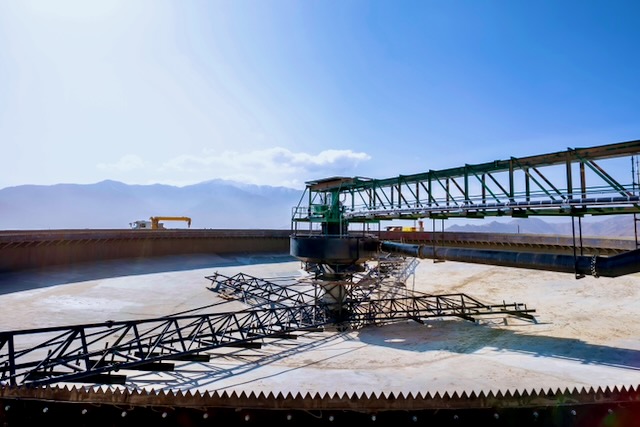
 The Hidden Cost of Poor Thickener Control- And How to Fix It
James Jenkinson
1. The Unforgiving Reality of the Underflow
If you aren’t hitting your underflow density, you’re moving mud and wasting water. In any dewatering circuit, the thickener has one job with two parts: recover clear water at the surface and produce high-solids tailings for disposal. On a spreadsheet, settling theory looks easy. In the field, it’s a constant battle against feed fluctuations, swinging between wide ranges in density and particle size affecting settling rate.
2. The High Stakes of Density Optimization
When density control slips, the “Downstream Domino Effect” hits hard:
- The Re-circulation Trap: When density is lost, operators are often forced to turn on re-circulation or manual slow the underflow pump to try and build inventory back up. It’s a band-aid that often masks deeper process issues.
- Filtration Crippling: If you’re feeding a filtration unit with low-density slurry, you’ve already lost. Filtration efficiency tanks, and your throughput follows it down.
- The Overflow Nightmare: “Solids bursts” in the overflow are a disaster if that water is re-circulated as flotation spray water. Those polymer-coated solids will disrupt flotation performance before you even realize the thickener has puked (Kosonen et al., 2017).
The Operational Risks of Poor Control:
- Clogging: Solids buildup in the cone leading to total blockage.
- Wasted Water: Lost recovery that kills your plant’s sustainability targets.
- Rake Failure: High mechanical strain that leads to the “graveyard of gears.”
3. The Measurement Headache: A Critique of Current Technologies
To control density, you have to measure it. But don’t let the marketing brochures fool you—most of these tools are a maintenance nightmare in a real-world environment.
Manual Sampling
Provides “historical data” at best. By the time the lab results are back, the process has already moved on (Montes-Q et al., 2020).
Hinders real-time decision-making; you’re always driving in the rearview mirror.
Nuclear Gauges
The “industry standard” that comes with a regulatory nightmare, specialized permissions, and ongoing safety risks (Kosonen et al., 2017; Montes-Q et al., 2020).
High investment and a heavy burden of red tape. The only thing more expensive than installing and operating radiological density is disposing of one.
Ultrasonic
Non-invasive but require “ad hoc post-processing.” Still largely in the prototype stage for full-scale industrial use (Montes-Q et al., 2020). Only usable on systems with very consistent particle size distributions without constant supervision and calibration.
Newtonian Density
Rugged and reliable if installed corrected. Newtonian density meters are the best option for underflow density.
Expensive but worth it.
4. The Pump Penalty: The Hidden Cost of High Density
There is a mechanical price for chasing that last percentage of density. To maximize underflow density, operators frequently reduce underflow pump speeds to increase residence time and bed height. This is where the trouble starts.
When pump speed is throttled back, the flow velocity often drops below a critical threshold, leading to particle settling. Once the fluid can no longer keep solids suspended, the consequences are purely destructive:
- Accelerated Erosion: Settled particles transform the pump casing into a grinder, scouring the impeller vanes and casing walls.
- Vortex Formation: Low flow rates trigger recirculation zones and vortices that trap abrasive particles, creating erosion hotspots that eat through metal.
- The Maintenance Spiral: This accelerated wear leads to deteriorated geometry, reduced hydraulic efficiency, and ultimately, premature failure and expensive downtime.
5. Conclusion: Moving Toward Robustness
There is a tendency to treat process control as something added once the hard engineering problems are solved. For thickener operation, that framing is backwards. The thickener sits at the intersection of your water circuit, your tailings management obligations, and your downstream processing efficiency. Leaving it to manual operation and reactive adjustment means accepting variability as a permanent condition — and variability in a thickener finds its way into every corner of the plant.
Purpose-built platforms like ThicAI represent a genuine step change in what is achievable: combining real-time sensor fusion, process modeling, and automated response logic to match the actual complexity of the problem. For operations facing tightening water targets, growing tailings liability, and pressure to demonstrate responsible practice, the question is no longer whether intelligent thickener control is worth the investment. The question is how much the absence of it has already cost.